
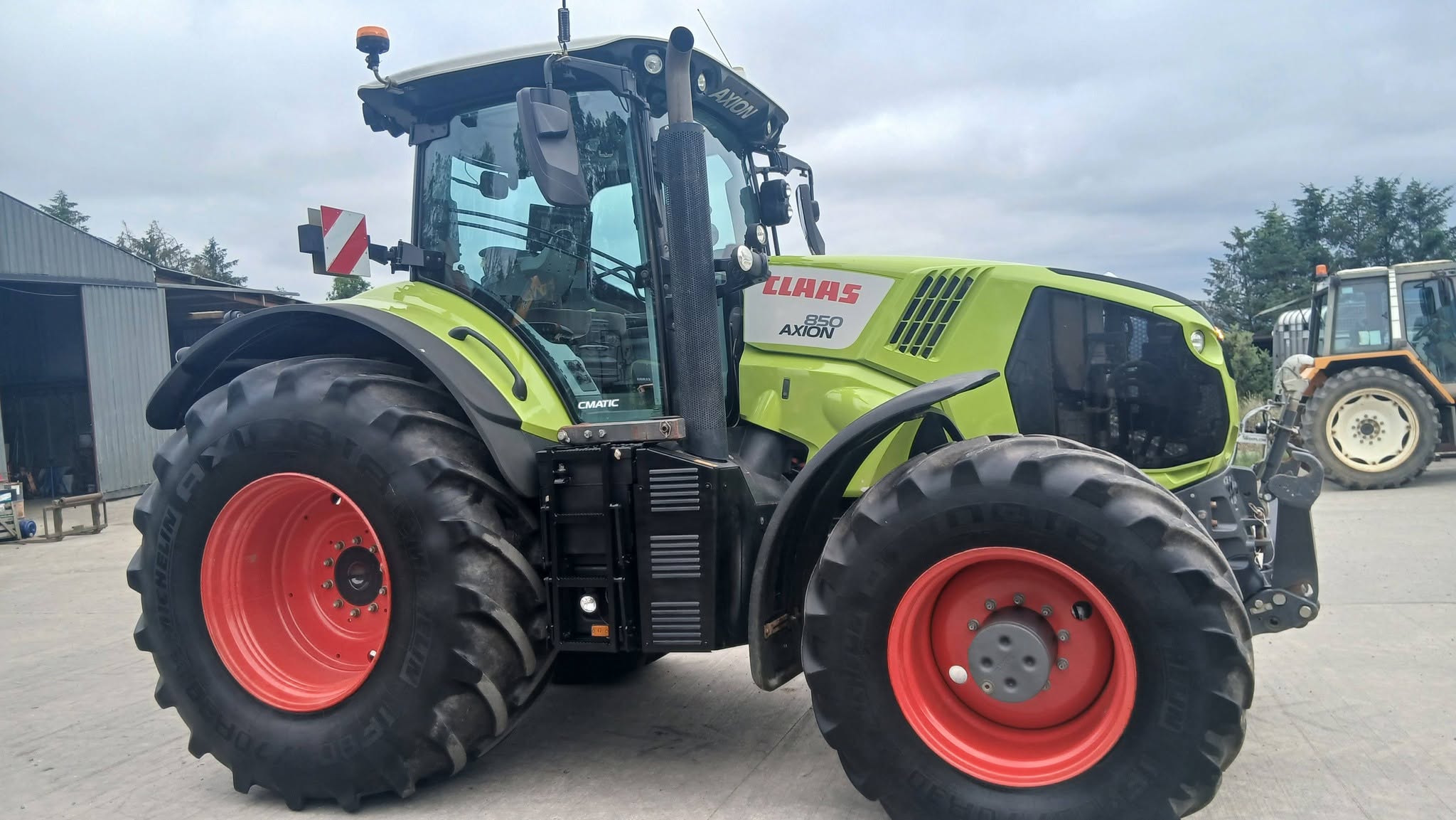
Used Claas Tractors for Sale: The Complete Buyer’s Guide
Hawkes Agri Sales — independent used Claas tractor specialists, Omagh, Co. Tyrone
If you’re looking for a used Claas tractor, you’ve probably already worked out that they hold their money better than most. Arions and Axions that are ten years old are still making serious prices, and there’s a good reason for that.
This guide covers the Claas tractor ranges, which model suits which farm, what to check before you buy, and what the hours on the clock actually tell you. We’re a family-run independent dealer in Omagh specialising in quality second-hand machinery, and Claas is what we know best.
Why Claas tractors hold their value
Three things keep second-hand Claas prices firm.
They were built to be worked. Claas came into tractors through the harvesting side of the business, and the machines were designed around contractors and larger farms who run them hard and long. That shows up in the back end, the hydraulics and the way they cope with sustained heavy draft work.
The cab is the best part of the machine. Anyone who’s sat in an Arion or an Axion after a day in something else will tell you the same. Visibility, noise levels, seat and armrest layout — it’s a proper place to spend twelve hours, and that matters more than horsepower when you’re buying for a driver.
Supply is tight. Claas has never had the market share of the green or the blue, so there are fewer used ones about. Fewer machines chasing steady demand keeps prices up — which is good news if you’re selling, and means you need to know what you’re looking at if you’re buying.
The Claas tractor ranges explained
If you’re new to the brand, the naming can be confusing. Here’s the shape of it.
Atos and Elios — the small end
Compact, straightforward tractors for livestock work, yard duties and smaller acreages. Mechanical transmissions, simple electronics, easy to live with. The Elios is the low-profile option and gets used a lot around sheds and in orchards.
Suits: yard tractor, small livestock farm, second machine on a bigger unit.
Arion — the workhorse
The Arion is the range most Irish and UK farms end up in. It runs from the 400 series up through the 500 and 600, covering roughly the 90hp to 200hp bracket depending on model and year.
The Arion 400 is the loader tractor of choice on a lot of dairy and beef farms — light enough on its feet, strong enough on the front end. Move up to the 500 and 600 and you’re into serious mixed-farming and light contracting territory.
Suits: the majority of farms. If you’re not sure where to start, start here.
Axion — the heavy work
The Axion 800 and 900 series are where Claas gets serious. Big draft work, ploughing, cultivating, large trailer haulage. These are contractor and large-arable machines, and the 900 series in particular is a lot of tractor.
Suits: contracting, large arable, anything that spends its life on the plough or the cultivator.
Xerion — the systems tractor
Four equal wheels, huge power, and a cab that can turn around. You don’t see many, but the ones about tend to be on slurry, muck or large-scale cultivation work.
The older stuff — Ares, Celtis, Nectis
Claas took over Renault’s tractor business, so machines from the mid-2000s carry a lot of Renault DNA. The Ares in particular still turns up as a good honest tractor at sensible money. Parts availability is generally fine, but check before you commit to anything unusual.
Which used Claas tractor suits your farm?
A rough guide, based on what we actually sell to people:
| Farm type | Sensible range |
|---|---|
| Small livestock / yard work | Atos, Elios, older Celtis |
| Dairy, loader work, mixed | Arion 400 / 500 |
| Larger mixed, light contracting | Arion 600, Axion 800 |
| Arable, heavy draft, contracting | Axion 800 / 900 |
| Slurry, muck, large-scale cultivation | Xerion |
The most common mistake we see is buying too much tractor. A big Axion on a farm that mostly does loader work and silage carting will cost you more in fuel and tyres than it ever saves you in capacity — and it’ll be worth less when you come to move it on, because the buyer pool is smaller.
Understanding Claas transmissions
This is the single biggest decision in the spec, and it’s where prices separate.
Manual and mechanical boxes — the older and simpler option. Reliable, cheap to fix, fine if the tractor lives in the yard or does repetitive work.
Powershift (HEXASHIFT and similar) — shifting under load without the clutch across a range of gears. A good middle ground for most farms: less to go wrong than a CVT, far nicer to drive than a straight manual.
CVT (CMATIC) — fully stepless, any speed you like, and by some distance the best option for road work, loader work and anything where you’re constantly changing pace. It carries a price premium new and used, and it’s more expensive if it goes wrong — so service history matters more here than anywhere else on the machine.
On the terminal: CIS is the simpler control setup, CEBIS the fuller screen-based one. CEBIS machines usually make more money and are worth it if you’re doing anything with guidance or ISOBUS implements.
What to check on a used Claas tractor
Whether you’re buying from us or from somebody else, here’s what we go over on every machine before it goes on the yard.
Hours against condition. A tractor that’s done 6,000 hours of road and trailer work is a different animal to one that’s done 6,000 hours on a plough. Look at the pedals, the seat, the steps and the armrest — wear on those tells you more about how it’s been used than the number on the dash.
Front axle and suspension. Suspended front axles are common on Arion and Axion, and they’re an expensive area. Get the front end off the ground and check for play. Listen for knocking on the road test.
The back end and linkage. Check the lift arms, the pins, the top-link bracket and the pick-up hitch. Look for oil weeping around the back axle and the spool block.
Spools and hydraulics. Work every spool. Watch for a slow response or a service that drifts. Count them, too — a tractor short on spools is a tractor you’ll be adding to.
Transmission behaviour, hot. Especially on a CVT. Drive it up to temperature, work it, and watch for hesitation, creep or any warning on the screen.
PTO under load. Not just spinning it — actually loading it if you can.
Service history and software. Ask what’s been done and when. Ask whether the machine is up to date on software. On a modern Claas, a full documented history is worth real money and its absence should be reflected in the price.
Tyres. Look at the percentage left and whether they’re a matched set. A set of rear tyres on a big Axion is a serious bill and it’s the thing most people forget to price in.
How many hours is too many?
There’s no single answer, but as a rough steer:
- Under 3,000 hours — a young tractor. Expect to pay for it.
- 3,000 to 6,000 hours — the sweet spot for most buyers. Depreciation has done its worst and there’s plenty of life left.
- 6,000 to 9,000 hours — perfectly workable if it’s been serviced and the wear items have been done. Buy on condition and history, not on the number.
- Over 9,000 hours — can still be a good tractor, but you’re buying a known quantity or you’re gambling. Get it inspected.
A well-maintained Claas with 8,000 hours and a full history is a better buy than a neglected one with 4,000. We’d tell you that even if it cost us the sale.
Buying from an independent versus a main dealer
Worth being straight about this, because it comes up.
We’re an independent used Claas specialist, not a franchised main dealer. If you want a brand-new machine with a factory warranty, a main dealer is where you go, and we’ll tell you that.
What an independent gives you is a different set of advantages: we buy across the whole market rather than just what’s traded in, so the choice is wider. We’re not carrying main-dealer overheads, so the money tends to be keener. And you deal with the person who bought the machine, not a sales process.
We’re straight about condition, we tell you the faults before you travel, and we’d rather lose a sale than sell you the wrong tractor.
Used Claas tractors at Hawkes Agri Sales
We’re a family-run business based in Omagh, Co. Tyrone, specialising in high-quality second-hand agricultural machinery, with a particular focus on used Claas tractors.
- Full details on every machine — hours, spec and price listed up front
- Delivery arranged across Northern Ireland and the Republic
- Finance available to spread the cost
- Trade-ins welcome — we’ll give you a straight number for what you’re in
- Sourcing service — tell us what you’re after and we’ll look for it
See our current used Claas tractors →
Or ring us and tell us what the tractor’s for. Half the job is working out what you actually need.
Frequently asked questions
Are Claas tractors reliable? Broadly, yes. They’re built around contractor use and the running gear stands up to it. As with any modern tractor, the electronics and the transmission are where the expensive faults live, which is why service history matters so much on a used machine.
Are Claas parts expensive or hard to get? Parts availability is good across the current ranges and the mainstream older ones. Some of the earlier Renault-derived models can take longer to source. It’s always worth asking before you buy anything unusual.
What’s the difference between an Arion and an Axion? Size and intended job. The Arion is the mid-range workhorse for general farm work; the Axion is the bigger, heavier machine built for sustained draft work and contracting.
Is CMATIC worth paying extra for? If the tractor does a lot of road work, loader work or anything with constantly changing speed — yes, comfortably. If it does repetitive field work at a set speed, a powershift will do the job for less money.
Do you deliver to the Republic of Ireland? Yes. We arrange delivery across Ireland, north and south.
Hawkes Agri Sales — quality used Claas tractors and agricultural machinery. Omagh, Co. Tyrone, Northern Ireland.
Add a comment Cancel reply
Categories
- Claas Tractors (1)
Recent Posts

About us

John Hendricks
Blog Editor
We went down the lane, by the body of the man in black, sodden now from the overnight hail, and broke into the woods..


Popular Tags

Copyright © 2024. All rights reserved.